Leveraging YouTube analysis for driving growth
As of now, YouTube is the 2nd largest search engine in the world. Marketers and business owners can learn a lot from the approaches clever creators have for building trust and driving traffic to their services.
The YouTube analyzer surfaces insights that viewers don't recognize, because it hits the subconscious and flies under the radar.
Most people research a YouTube channel the same way. They open a few videos, scan the view counts, and try to build a mental model from scattered impressions.
That approach can work, but it is slow and error prone. It also leaves a lot unresolved once the first pattern seems obvious.
You can tell that a video did well. It is harder to tell whether it was a real outlier, what promise it made, who it was really speaking to, and whether its success is something you can learn from or just admire from a distance.
Go beyond the first patterns.
YouTube does not suffer from a lack of visible signals. Titles, thumbnails, view counts, upload dates, lengths, comments, and adjacent recommendations are all right there.
The harder part comes later, though. Once you have opened enough tabs, you still need to turn that pile of signals into a useful read on the channel. What is normal here? What is genuinely exceptional? Is a video winning because of the topic? Because of the storytelling? Or is it only the packaging?
That is the job the analyzer is meant to do. Instead of treating a channel like a pile of unrelated uploads, it turns the recent catalog into a pattern map and hashes out selected videos for valuable insights.
The tool creates a channel snapshot, a baseline for what normal performance looks like, and a clearer path to the videos that deserve a closer read. You can choose to drill deeper into high-performing videos by analyzing them individually with the tool.
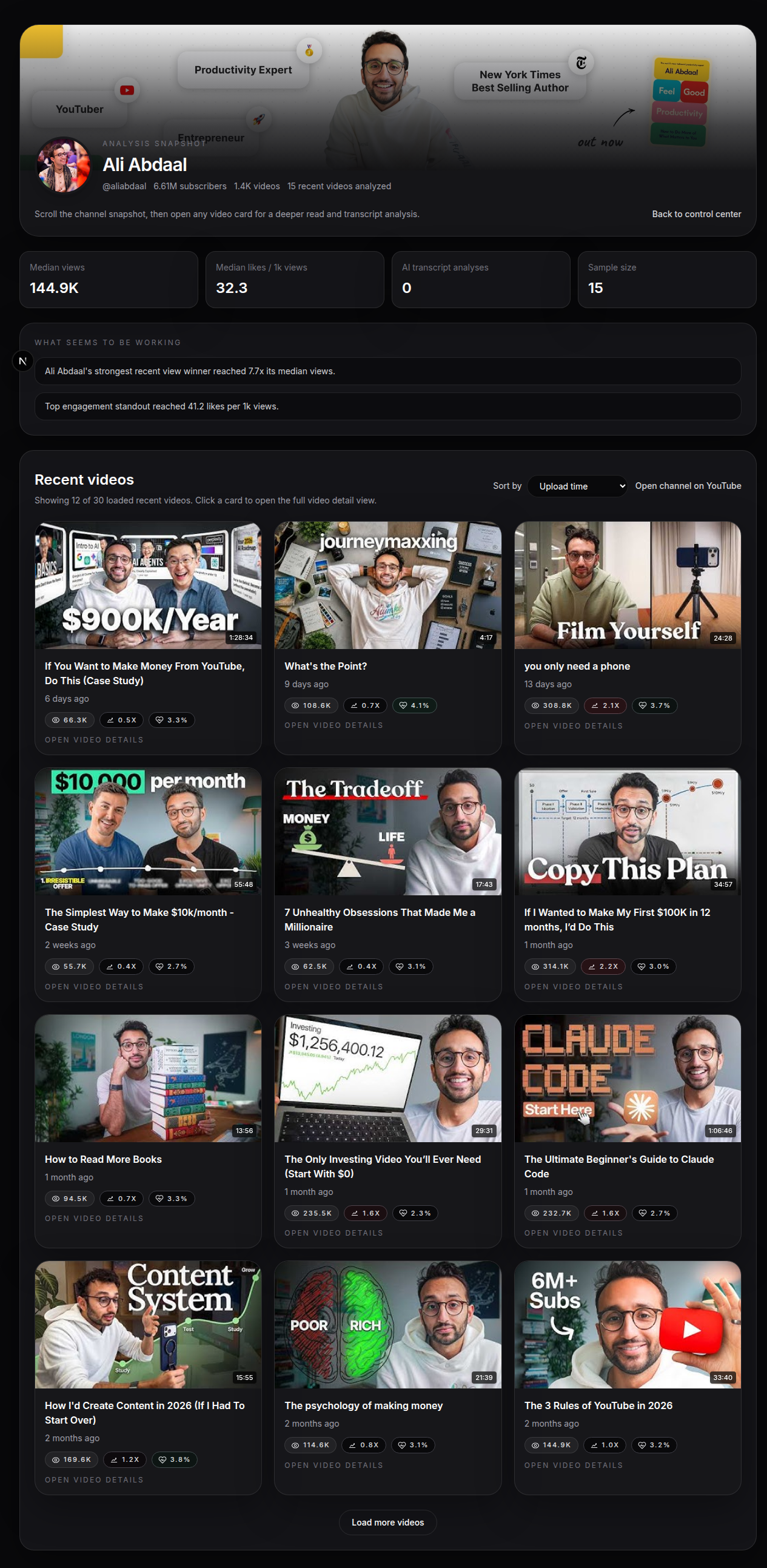
A channel snapshot changes what you notice
When the important signals live together, you stop overreacting to one big hit or one disappointing upload. The channel becomes easier to read as a whole.
You can see whether views are concentrated in a few breakout videos or spread more evenly across the catalog. You can see whether recent uploads are climbing, flattening, or leaning on the same format too often.
Choosing your next topic becomes way easier. Just look at the snapshot, see what has worked, and branch from there.
Outliers are good, but only if you can interpret them
The highest-viewed videos on a channel are usually where people start. That makes sense, but a top performer is not automatically a strategy.
Sometimes a video wins because the topic had built-in demand. Sometimes it wins because the title made a sharper promise. Sometimes the format was more specific, the guest was stronger, or the packaging was simply better than usual.
A useful analyzer helps narrow the field before you do the deeper work. It shows you what deserves a closer look, so you can spend your time interpreting the right examples instead of browsing at random. Outliers are the starting point for better ideas that resonate with your audience.
Individual analysis gets you closer to why a video worked
Surface-level metrics can tell you what won attention. They cannot fully explain how the video held it or how the argument unfolded once the viewer clicked.
Transcript-level analysis helps with that next layer. You can inspect the structure, the repeated themes, and the way the creator frames the value of the video.
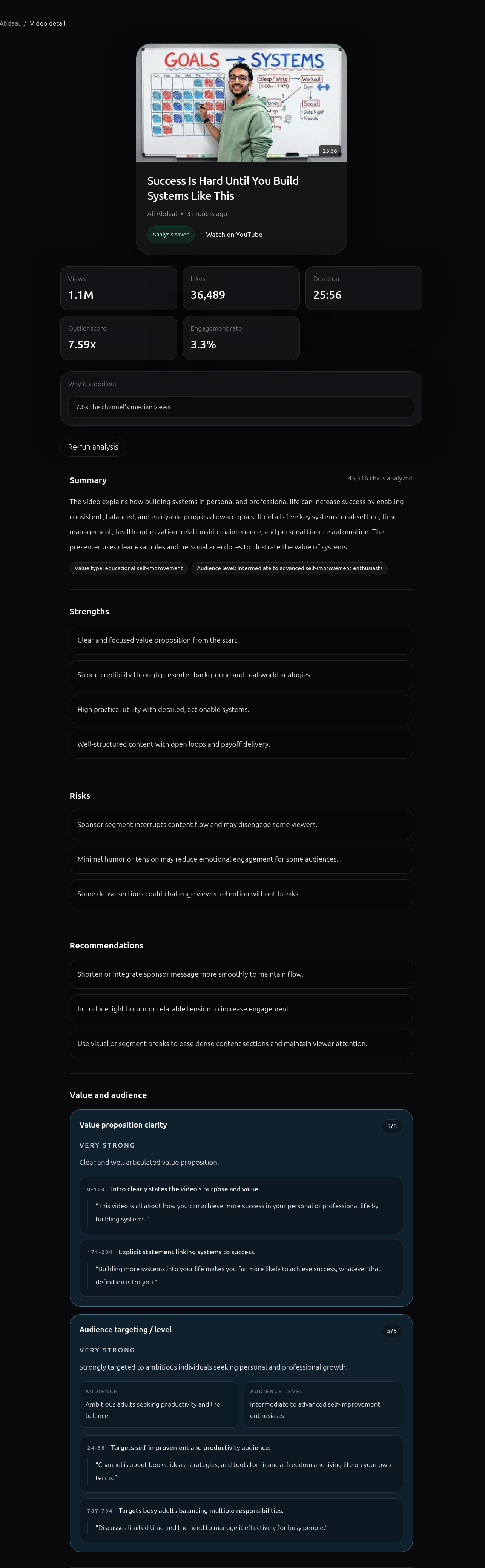
That makes idea mining more practical. You move from "this topic seems to work" to a more useful read: this is how the creator opened the loop, how they kept momentum, and how they translated a broad topic into a concrete promise.
For anyone trying to make better videos, briefs, or research notes, that is a much more actionable starting point than raw view counts alone.
Useful for more than creators
Creators can use this kind of analysis to plan a stronger editorial calendar. It helps them see which themes are repeating, which formats are drifting, and where a channel may be underexploring a promising angle.
Agencies can use it to benchmark a client against their own history, not just against generic advice. It also gives them a faster way to audit adjacent channels before recommending a content direction.
Operators, researchers, and niche businesses can use the same workflow to understand what audiences in a space keep responding to. In that sense, it is not only a YouTube tool. It is also a lightweight research tool for demand, framing, and message clarity.
Facilitate repeatable research
The real value is being able to run the same analysis repeatedly across channels, topics, and time periods without starting from zero every time.
This matters a lot if content is part of your growth strategy. You need a way to revisit the same niche, compare patterns, save what you learned, and turn observations into a process the team can use.
Want help turning channel research into a clearer content strategy?
If you want help researching content with these systems, or turning it into a complete workflow for your business, get in touch or book a short intro call.